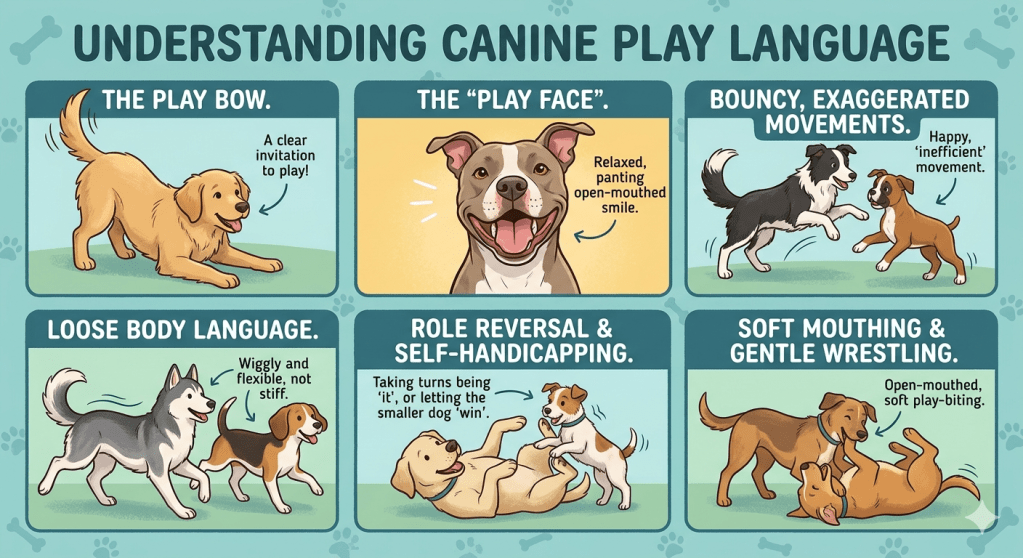
Understanding Canine Play Language
(Objective: To give an understanding of how dogs express themselves when playing.)
Why is it being taught?
- Real life application: You will be able to better identify your dog’s, and other dog’s, play behaviour. This can reassure you that the dogs are playing and not heading for a conflict. Behaviours in play that drift towards Prey-Drive, or the Ladder of Aggression, indicates the need to redirect the dogs to another activity – you need to recognise this!
- Likely Life Rewards: Being aware of what is dog play and what is not can help you prevent confrontation between your dog and others. It will allow you to choose appropriate playmates for your Dog. You will be able to let your dog play safely and satisfy their social needs.
Your Homework! – Training Documents:
This page has the information you need for this Quiz.
However, please use the internet to research your dog’s breed or mix of breeds. It’s important to know the likely characteristics of your dog’s breed when playing.
Play styles in dogs are reasonably similar. However, breeds can differ according to the function they have been selected for. Due to this some breeds may need to play with a narrower range of playmates. However, it is often the case that an individual dog’s personality, rather than the breed, dictates how they play. You never know until you try! There are introduction protocols that we use to make play date as safe and successful as possible.
- You are welcome to use the material that has been provided whilst you take the quiz/test.
- There are ten multiple choice questions and please make sure that you actually SUBMIT the completed webform.
- Research your dog’s breed or mix of breeds so that you can tell the class what play you are likely to see in your dog.
Key body language signs dogs use when they are playing.
It looks like chaos when dogs play. However there is structure and purpose to it.
Dogs have evolved sophisticated play that serves several crucial purposes. Whether they are running after each other, wrestling, mouthing, chasing a ball, or engaging in a tug-of-war, they are practicing life skills and gaining satisfaction as well as building bonds with playmates.
Dogs and other species, that play into adulthood are rare. Most animals abandon play when they reach maturity, dogs retain their puppy playfulness for life.
However, you may have to encourage your dog to play if it hasn’t been a feature of their earlier life. Puppy’s that stay with their mother and littermates for longer, say 12 weeks instead of just 8, are much more practiced in play. So please play with your dog, don’t worry about what other people think. It’s easy to do a play bow (see below) and your dog should respond!
Why Dogs Play
- Safe Practice: Chasing, pouncing, wrestling, and shaking toys are play versions of predatory behaviours.
- Physical Fitness: It develops agility, muscle tone, balance, and cardiovascular health.
- Social Etiquette: Learning what’s acceptable to other dogs – the rules of being a pack member.
- It Feels Good: It satisfies a great deal of the dog’s needs and gives them optimism about their life.
- Builds Bonds: The feel good hormones released by play bonds your dog to you and their playmates.
“I’m Just Playing” Signals
Dogs use specific cues as punctuation marks to ensure their play partners know their intentions are entirely friendly.
- The Play Bow: This is the international canine symbol for “Game on!” A dog lowers their front legs and chest to the ground while keeping their rear end high in the air. It’s their way of saying that anything that follows—even a rough tackle—is purely for fun.
- The “Play Face”: You’ll see an open, relaxed mouth, often looking like a goofy smile. Their eyes will be soft rather than hard or staring, and their ears will be in a neutral or relaxed position.
- The Play Sneeze: If you hear a dog forcefully snorting or sneezing during a play session, they aren’t catching a cold. Dogs use a “fake sneeze” to communicate, “Hey, we’re just fooling around, no offense intended!” It is a common way to de-escalate tension.
Movement and Choreography
Healthy dog play has a distinct rhythm. Unlike real fighting, which is rigid and efficient, play is inefficient, bouncy, and exaggerated.
- Loose “S” Shape “Wiggly” Body,: A playing dog’s body looks relaxed and wiggly. If you look at them from above, they tend to move in curves and S-shapes rather than stiff, straight lines.
- Role Reversal: In a good play session, dogs will take turns being the “winner” and the “loser.” One dog chases, then they switch and get chased. One pins the other, then they swap. If one dog is doing all the chasing or pinning and won’t let the other up, it’s shifting away from play – aggression or prey drive may have been triggered..
- Self-Handicapping: Big dogs or more skilled players will consciously hold back so their partner can stay in the game. A large dog might lay on its back to let a puppy “win,” or bite with only a fraction of its actual jaw strength.
Play Vocalisations
Sound can be the most confusing part of dog play, as it often sounds terrifying to humans.
- The Play Growl: Play growls are usually higher-pitched or more varied than serious, throaty warning growls. The biggest differentiator is the body language attached to it: if the dog is growling but their body is loose, wiggly, and they are doing a play bow, it’s just part of the theatrics.
- Repetitive, High-Pitched Barks: These are often used to get another dog’s attention or invite them to keep playing.
- The “Consent Test”: If you aren’t sure that both dogs are having fun, gently hold back the dog who seems to be the aggressor or the more energetic player. If the other dog walks away to take a break, the play was getting too intense. If they immediately run back to the dog you’re holding and ask for more, they were both having a great time!
Real life play – from our Clever K9s
Signs Play Has Turned Serious
It helps to know what is not play. Always observe your playing dogs and step in to give the dogs a break if you notice:
- Stiff, frozen posture or bodies moving in rigid, straight lines.
- Closed mouths with curled lips and a hard, unblinking stare.
- Tails tucked tightly between the legs (signalling fear) or held straight up and vibrating rigidly (signalling high arousal/aggression).
- Yelping or whimpering that causes the other dog to press harder rather than backing off.
Some dogs are difficult to read
Sometimes the physical features of a breed can cause other dogs to not be able to read their play body language. This can lead to conflict if a dog sees a physical feature as indicating aggression.
- Flat faced dogs can look aggressive to other dogs due to wrinkled faces and teeth on show.
- Tails that curve up and over can indicate a dog preparing to dominate or be aggressive.
- Wrinkled faces on some full faced dogs can look like a snarl, which is just one step below a bite.
- Dogs who’s coats appears to stand on end can appear to have their hackles raised. e.g. Husky types.
These dogs still want to join in play. However, if a dog has these features, it’s harder for you and your dog to use body language to read a dog’s intentions. Attempts at play may be problematic. Use introduction protocols and be careful about any apparent arousal to non-play interactions.


