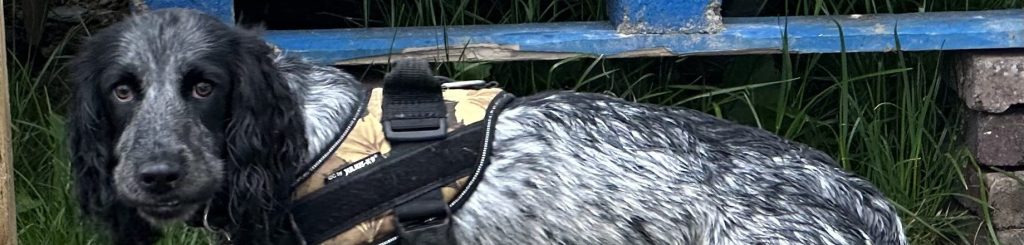
Eye Contact
Pre-class Training
Eye Contact
(Objective: The dog develops a self-driven action of visually checking-in with their handler.)
Why is it being taught?
- Real life application: Your dog’s focus is on you and your movements.
- Likely Life Rewards: Your dog will be easier to manage and harder to distract as it offers the opportunity to use visual as well as audible cues. It can contribute to loose-lead walking and walking close in later sessions.
Preparation.
- Venue: Initially best done at home with no other dogs being present and at a quiet time that is free of distractions.
- Equipment/Supplies: Gather the equipment and supplies required,
- Have a number and variety of high value rewards to hand. (See Reward Selection).
- Dog harness and Collar.
- Walking Lead.
- Long line/lead (only for use with harness).
- Note: When fluent in this skill the appearance of a visual distraction (e.g. another dog) should prompt the dog to look to you. This gives you an opportunity to visually/verbally cue a Mutually Exclusive Behaviour (MEB).
- Starting positions:
- Handler: The handler sits (or stands) with the rewards to hand but out of sight.
- Dog: In same space and nearby on the walking lead.
Audible & Visual Cues.
- Audible cues: No cue word is used to prompt the dog’s check-in, only speak to mark the eye contact. It’s important to mark & reward only when the dog offers eye contact. This links the self-driven action of visually checking-in with a reward from their handler.
- Marker Word – “Good”.
- When: “Good” is used to mark the correct behaviour. Mark only for a correct action and give the reward within two seconds of the mark.
- How: Use appropriate volume for the conditions.
- Meaning to the dog: The use of a consistent marker word informs the dog that it is about to receive a reward. It keeps the dog’s attention.
- Visual cues: Visual cues must be unique, simple, unambiguous, and consistent. See the (Using Visual Cue pamphlet).
- When: The same time as you say “Good”.
- How: Look directly at your dog’s eyes with a friendly encouraging expression.
- Meaning to the dog: Captures the dog’s interest and prompts it to explore what marker word means.
Practice. (Mark only when the dog offers eye contact: Offer reward within two seconds of the mark)
Layer 1: The layer 1 focus is to mark & reward the dog every time it looks at you.
- Handler has,
- Upright stance.
- Not to move away from their position.
- Walking lead in favourite hand (attached to the dog).
- Rewards easily available to give by free hand.
- Keep rewards out of sight.
- Do not use rewards to “lure” the dog.
- Rewards to be given every time the dog looks at you.
- Dog on the walking lead.
- Mark and reward the dog every time they look at you.
- Repeat layer 1 until the dog is giving the required behaviour.
Layer 2: The layer 2 focus is to get the dog’s attention with the handler in a different position.
- Handler has,
- Upright stance.
- Will be moving slowly away from their position in a direction towards open space.
- Walking lead in favourite hand (attached to the dog).
- Rewards easily available to give by free hand. (Same reward rules as last layer.)
- Rewards to be given every time the dog looks at you.
- Dog on the walking lead.
- Mark and reward the dog every time it looks at you.
- Repeat layer 2 until the dog is giving the required behaviour.
Layer 3: The layer 3 focus is to get the dog’s attention whilst on the long line/lead and walking with greater freedom and access to distractions.
- Handler has,
- Upright stance.
- Will be moving slowly away from their position in a direction towards open space.
- Long line/lead in favourite hand attached to dog by the harness (not the collar).
- Rewards easily available to give by free hand. (Same reward rules as last layer.)
- Rewards to be given every time the dog looks at you.
- Dog on Long line/lead attached to the harness (not the collar).
- Allow the dog to move naturally and investigate the surroundings.
- Mark and reward the dog every time they look at you.
- Repeat layer 3 until the dog is consistent with the required behaviour.
“Homework.”
- Carry rewards at home, etc. and mark & reward for eye contact when it happens during the normal course of life at home. Same for on walks.
- If the dog is indicating for their dinner, to have a door opened, a toy thrown, etc. only mark and give them what they want following eye contact. (To condition checking in before getting what they want).
- Place a reward somewhere the dog can see it but can’t reach. Mark and give the reward for eye contact. Use this to increase the duration of the check-in by delaying the reward whilst the dog is looking at you.
- Move away from the placed reward and mark and give the reward when the dog approaches you to give eye contact. Repeat whilst varying your position in relation to the placed treat.
- If you don’t have a treat/toy to hand for a reward, mark & praise instead for any impromptu eye contact.
- Habituate the dog to check-in whilst in various real-life environments. Practice every time you are out with your dog.
- Sit or stand and drop a reward on the floor (so that the dog notices). Mark and reward by hand for looking at you for more.
- Sit or stand and drop a reward on the floor (so that the dog notices). Mark and drop a further reward for looking at you for more.
- Repeat Paragraphs 17. & 18. above whilst turning around through a circle and using the drop, or hand reward method. (Use a mix of the reward methods).
- Walk as normal whilst dropping a reward and use the mark & dropped reward method for eye contact. Continue walking whilst marking & rewarding for eye contact.
- Play a favourite game as the reward for eye contact.
- Keep management and control as appropriate to the environment.
Fluency.
Consider the dog achieving fluency when the skill has become generalised for use in different environments. To confirm the skill test for the following,
- Distance: Turns and looks at you frequently from a variety of distances appropriate to the walking environment.
- Duration: Keeps focus on you long enough for you to give a redirecting verbal cue if needed.
- Distraction: The dog looks to you before investigating anything off the walking route.
- Latency: They quickly turn to look of their own accord.
- Precision: Consistently checks-in for any change in the environment.
- Speed: Checks in slowly enough for you to respond if needed.


 Clever K9s