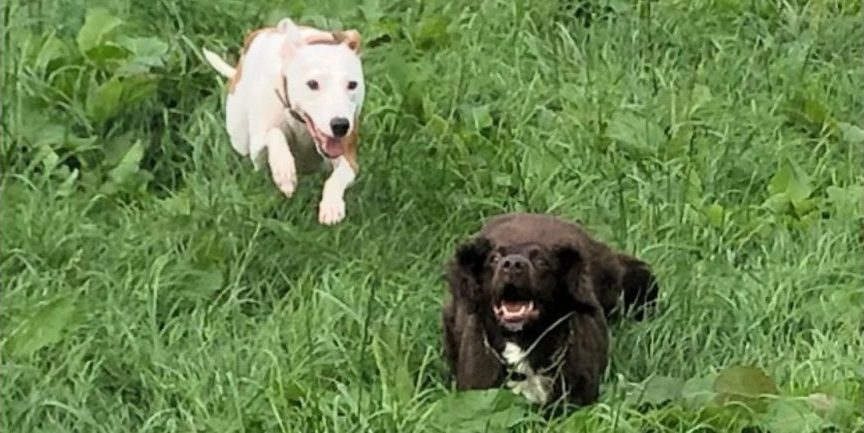
Conditioning Recall Cues
Pre-Class Training
Conditioning Recall Cues.
(Objective: The dog hears the recall cue and expects good things to happen where you are.)
Why is it being taught?
- Real life application: To bring your dog to you for better control.
- Likely Life Rewards: Can literally be a lifesaver for your dog and will give you a response to use for further training.
Preparation.
- Venue: Initially best done at home with no other dogs being present and at a quiet time that is free of distractions.
- Equipment/Supplies: Gather the equipment and supplies required,
- Have a number and variety of high value rewards to hand. (See Reward Selection).
- Brief: Tell any human companions exactly what you want them to do and not to do.
- Note: The treating in this practice is not a reward for a taught behaviour. This is classical conditioning. Delivery of the reward is repeated after the recall cue to link it with a reward from their handler. Be patient and do not show frustration as this could hinder training development.
- Starting positions:
- Handler: The handler sits (or stands) with the rewards to hand but out of sight.
- Dog: In same space and nearby.
Audible & Visual Cues.
- Audible cues: The word “Come” is clear when shouted and carries well amongst a normal level of distractions and noise.
- “Come”
- When: When you want the dog to return to you.
- How: Use appropriate volume for the conditions
- Meaning to the dog: Use of the “Come” indicates that rewards and good things are about to happen where you are.
- “Come”
- Visual cues: Visual cues must be unique, simple, unambiguous, and consistent. See the (Using Visual Cue pamphlet).
- When: Same time as you say “Come”.
- How: Look directly at your dog’s eyes with a friendly encouraging expression.
- Meaning to the dog: Captures the dog’s interest and prompts it to explore what it means. i.e. There could be something in this for me.
Practice.
Layer 1: The layer 1 focus is to use the dog’s name to get their attention,
- Handler (you) has, an upright position/stance by the supply of rewards with their dog nearby. Do not move away from there.
- Handler says – “Come”.
- Regardless of what the dog is doing, within two seconds of saying the “Come”, give the dog the reward.
- Repeat layer 1 to reinforce the recall to “Come” response.
- Repeat until the dog is giving the required behaviour.
Layer 2: The layer 2 focus is to get the dog’s attention with the handler in a different position.
- Handler has, an upright position/stance by the supply of rewards with their dog nearby.
- Occasionally moves position.
- Handler says – “Come”.
- Regardless of what the dog is doing, within two seconds of saying “Come” give the dog the treat.
- Repeat layer 2 to reinforce the recall to “name”Come” response.
- Repeat Layer 2 until – when the dog hears “Come” they turn immediately towards the handler.
“Homework”.
- Repeat the practice frequently to reinforce the reflex to “Come”.
- Habituate the dog to the use of “Come” in various real-life environments.
- Practice every time you are out with your dog.
- Keep management and control as appropriate to the environment.
Fluency.
Consider the dog achieving fluency when the skill has become generalised for use in different environments. To confirm the skill test for the following,
- Distance: Responds from the next room or, from the garden.
- Duration: Having returned to your side the dog keeps focus on you long enough for you to give another cue.
- Distraction: Will still return to you if giving attention to someone else.
- Latency: They turn immediately to focus on the handler.
- Precision: No excessive repeating of the audible cue by the handler.
- Speed: When returning the dog should do so with direct enthusiasm and best speed.


 Clever K9s